

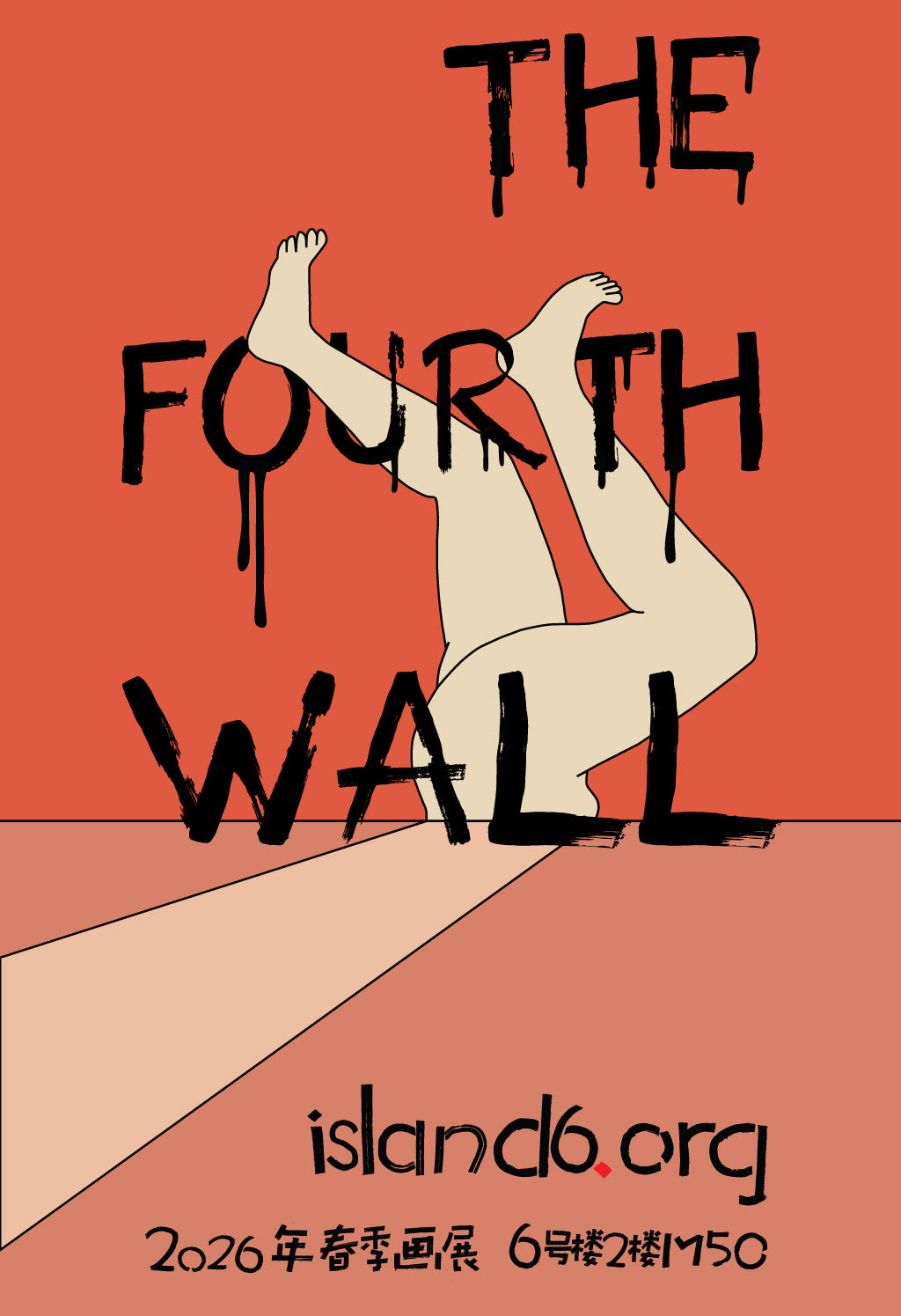
“The Fourth Wall” (第四面墙)
ABOUT
In theater and film, the “fourth wall” is the invisible boundary separating the performer from the audience, a fragile membrane that holds the illusion intact. In this exhibition, that membrane becomes the subject itself: stretched, punctured, observed, and ultimately questioned through photography, video, and the simple act of looking. Here, the camera is not a neutral witness but a mischievous accomplice, whether a vintage “Yashica Flex” with its square frame and waist-level gaze, or a “Yashinon” lens quietly harvesting light, forever renegotiating the terms of who watches whom.
Photography has always lived in this tension. To photograph is to enter someone’s orbit, to claim a moment as one’s own, to assign meaning to what might otherwise slip by unrecorded. French conceptual artist Sophie Calle, best known for turning acts of observation into intricate narratives, understood this intimately. Her shadowing of strangers, her tender invasions, and her quiet documentation of private routines reveal how the act of looking can be both affectionate and unsettling. Calle’s methodology, a blend of curiosity, mischief, and emotional risk, lingers as a ghostly reference throughout The Fourth Wall. Her work reminds us that the camera is a threshold where our interior world meets another’s without permission, ceremony, or warning.
American visual artist, Dan Graham expands this threshold into architecture. His mirrored pavilions and time-delayed video corridors fracture perception, placing viewers inside live feedback loops. In the 1970s, Graham’s installations turned spectators into performers, implicating them in their own self-surveillance at a time when surveillance was hardly a staple of everyday life. Long before the “selfie” became a cultural reflex, Graham’s work anticipated a world in which the self is constantly rehearsed for the camera; performed, edited, and archived in real time.
Today, in an era of omnipresent cameras, facial recognition, and algorithmic witnessing, his experiments feel prophetic. What happens when our reflection arrives a second late, or a fraction early? Who are we performing for when no one, or everyone, might be watching?
These Western conceptual anchors intersect in China with philosophical traditions that have long considered the relationship between observer and observed. Zhuangzi’s famous parable, “the dream of the butterfly,” collapses the boundary between self and world, waking and dreaming, seer and seen. In the “Yijing,” or “Book of Changes,” reality is framed as a field of constant transformation through its shifting hexagrams, suggesting that perspective is never fixed. Even Chinese calligraphy underscores this fluidity: each stroke is both language and gesture, a trace of the writer’s presence that turns writing into a form of storytelling. In a single character, the viewer encounters not just meaning but movement, the rhythm of the hand, the breath, the moment of creation, blurring the roles of reader, witness, and participant. In every case, the line between the viewer and the viewed dissolves, echoing the porous edges of the fourth wall itself.
Cinema adds another dimension to this exchange. Hitchcock’s film “Rear Window” (1954) hovers like a quiet blueprint behind the exhibition, a reminder that the simple act of observing can blur into desire, projection, suspicion, and story-making. Windows frame lives; cameras seal them into narrative; screens give us the illusion of distance. Yet as the film famously suggests, any window we look through is also a window someone else might be looking into. Each viewer carries a flicker of voyeur, unwittingly or otherwise.
The Fourth Wall gathers these currents, conceptual, cinematic, philosophical, into a single field where images do not simply document life but reshape our position within it. The works here play with surveillance, intimacy, performativity, and the elastic boundaries between public and private; from the slow attentiveness demanded by a “Super Takumar Asahi” to the instant gratification promised by an “Instamatic”, and onward to today’s frictionless image-making. They invite viewers to inhabit the unsettling, delightful moment when the gaze reverses direction, like a “Red Silhouette Rear Window”, momentarily visible, impossible to unsee. When the image tilts its head. When the wall wavers just enough for you to feel yourself being seen.
In crossing that invisible boundary, the exhibition asks: What does it mean to witness in an age where witnessing is constant? How do we navigate a world in which every gesture might already be archived? And at what point does looking become participation, versus confession?
The Fourth Wall doesn’t answer these questions; it stages them. Step inside, and the performance begins the moment you notice the cameras were never pointed at the artwork alone.DATES
Spring 2026
Spring 2026
CURATION
Tiara Alvarado-Leon
ART DIRECTION
Thomas Charvériat
ART RESEARCH
Helen Chen 陈韵涵, Serena Charvériat-Young 杨倩菁
ARTISTS
island6 art collective (Liu Dao 六岛)
VENUE
island6, 50 Moganshan Road, building #6, 2/F, Shanghai
Tiara Alvarado-Leon
ART DIRECTION
Thomas Charvériat
ART RESEARCH
Helen Chen 陈韵涵, Serena Charvériat-Young 杨倩菁
ARTISTS
island6 art collective (Liu Dao 六岛)
VENUE
island6, 50 Moganshan Road, building #6, 2/F, Shanghai